Editorial Link Platforms in 2026
Reviews of Mention Match, Source of Sources, SourceBottle, Connectively, Featured, Qwoted, Journo Requests and New Entrants
Editorial links from journalist requests remain one of the most cost-effective ways to earn high-authority backlinks and AI citations. The landscape has shifted dramatically since HARO’s original shutdown and relaunch, with new platforms, verification gates and AI-detection tools reshaping what works. This article analyses each major platform in detail, highlighting strengths, weaknesses and real-world performance. A comparison table at the end ranks them across key metrics with clear grades.
Mention Match
Mention Match positions itself as a B2B-focused matching service, connecting writers who need quotes with sources seeking coverage. The platform claims over 8,000 sources and emphasises automated matching rather than manual searching. Strengths include a narrow B2B focus that can reduce noise for SaaS and professional services, and a free profile setup. However, the platform is relatively new and less established than competitors. Query volume is lower than broader platforms, and the matching algorithm can be hit-or-miss. Some users report long periods without relevant matches, particularly outside core B2B tech verticals. The interface is functional but basic, with limited filtering or search capabilities. Customer support appears minimal, with most guidance provided through self-serve documentation. Overall, Mention Match is a decent supplementary tool for B2B brands but lacks the volume and polish of market leaders.
Source of Sources
Source of Sources has emerged as the closest spiritual successor to the original HARO experience, offering free daily digests of journalist requests. The platform is founder-backed and emphasises quality enforcement, with a fast pace and minimal tooling. Strengths include high query volume across broad topics, completely free access and a community that values authentic expert commentary. The email-based format is familiar and efficient for experienced users. Weaknesses include a lack of advanced features like profile building, response tracking or analytics. The platform relies heavily on user discipline to filter relevant requests, and competition per query can be intense. Customer support is essentially non-existent, operating on a community-driven model. Despite these limitations, Source of Sources delivers consistent results for those willing to invest time in daily monitoring and rapid responses.
SourceBottle
SourceBottle is an Australia-based platform that has expanded internationally, offering journalist requests across lifestyle, consumer and general topics. The platform is fully free for sources, with email-based digests and a straightforward interface. Strengths include strong coverage in Australian and UK markets, a focus on consumer and PR-style stories, and a reputation for genuine journalist engagement. Weaknesses include lower query volume compared to US-centric platforms, a dated interface that feels legacy, and limited B2B or technical vertical coverage. Response rates typically range from 4 to 7 percent, with link quality in the DR 25 to 55 range. Customer support is minimal, with most users relying on community forums and self-help resources. SourceBottle remains a solid choice for lifestyle, consumer and regional PR but is less effective for B2B or high-authority business placements.
Connectively (HARO Relaunch)
Connectively is Cision’s relaunched version of HARO, operating under new ownership after the original platform’s shutdown. The platform retains the classic three-times-daily email digest format and remains free for both journalists and sources. Strengths include massive query volume across all topics, brand recognition and a large existing user base. However, the relaunch has been plagued by issues. The platform is flooded with low-quality AI-generated pitches, making it difficult for journalists to find genuine experts. Many journalists now filter out AI-written responses, reducing effectiveness for all users. Verification is minimal, leading to spam and irrelevant pitches. Customer support is reported as slow and unresponsive, with frequent technical issues. While Connectively still delivers volume, the signal-to-noise ratio has deteriorated significantly, making it less effective than in its prime.
Featured
Featured operates as an AI co-pilot for PR, combining journalist requests with podcast opportunities, speaking engagements and other earned media channels. The platform owns HARO and Connectively, positioning itself as a comprehensive earn-media solution. Pricing starts with a free tier offering daily credits, then Lite at $29 per month and Pro at $79 per month. Strengths include a modern interface, AI-powered matching and filtering, multi-channel opportunities beyond just journalist requests, and active development. The CEO has publicly acknowledged the AI-pitch problem and implemented detection tools to help journalists filter spam. Weaknesses include a learning curve for new users, variable query quality depending on vertical, and a pricing model that may deter smaller operators. Some users report that the AI matching can be overly aggressive, surfacing marginally relevant opportunities. Customer support is better than most competitors but still limited at lower tiers. Featured is a strong all-rounder for brands seeking diverse earned media, not just backlinks.
Qwoted
Qwoted is a verification-first platform connecting over 30,000 journalists with more than 100,000 vetted experts. The platform emphasises quality over quantity, with a focus on tier-one business, finance and tech publications. Pricing includes a free tier with limited access and Pro plans starting around $99 to $149 per month. Strengths include rigorous journalist and expert verification, high-quality requests from major outlets like Forbes, Business Insider and Newsweek, and a clean, professional interface. Approval rates hover around 6 percent, which is significantly higher than the cold-pitch baseline. The platform’s matching system reduces noise for journalists and increases relevance for sources. Weaknesses include lower overall query volume compared to free platforms, a pricing barrier for smaller operators and a competitive approval process. Customer support is responsive but primarily geared toward paid users. Qwoted is the best choice for brands targeting high-authority business and finance placements, provided they can meet the quality bar.
Journo Requests (X/Twitter and Other Social Channels)
The #JournoRequest hashtag on X (formerly Twitter) and similar social channels remains a real-time source of journalist queries. Strengths include immediacy, direct access to journalists and no cost. Queries are often posted with tight deadlines, creating opportunities for rapid responses. Weaknesses include extreme volatility, no verification of journalists or requests, and a high risk of spam or low-quality opportunities. The signal-to-noise ratio is poor, requiring significant time investment to filter relevant requests. There is no customer support, as the platform is essentially a public hashtag. Success depends on being highly active, responsive and able to craft quick, compelling pitches. This approach works best for experienced PR professionals who can move fast and recognise genuine opportunities. For most brands, it should be a supplementary channel rather than a primary strategy.
New Entrants and Emerging Tools
Several new tools and platforms have emerged in 2026, aiming to address gaps in the editorial link market. These include AI-powered pitch drafters, link-gap analysis tools and hybrid platforms combining journalist requests with other earned media. Some focus on automating the matching process, while others emphasise AI-detection to filter spam. Strengths include modern technology, fresh approaches to old problems and potential for innovation. Weaknesses include limited track records, unproven effectiveness and potential reliability issues. Many are still in beta or early stages, with small user bases and minimal community feedback. Pricing varies widely, from free trials to premium subscriptions. Customer support is typically limited, with most platforms relying on self-serve resources. These tools are worth monitoring but should not replace established platforms until they demonstrate consistent results.
Mention Match
Praise (from users/industry)
Users in B2B SaaS communities note the automated matching saves time compared to manually searching through hundreds of daily queries, with one founder reporting three qualified matches in the first month for a niche enterprise software product.
Criticism (from users/industry)
Multiple SEO practitioners on Reddit describe the platform as "too new to trust" with inconsistent query quality, noting that matches often feel irrelevant to their actual expertise and the volume drops significantly after the first few weeks.
Source of Sources
Praise (from users/industry)
Experienced link builders on affiliate marketing forums praise it as "the closest thing to old HARO" with high query volume across broad topics and completely free access, with one user reporting 15 placements in six weeks from consistent daily responses.
Criticism (from users/industry)
Users complain about the lack of any filtering or search functionality, meaning you must manually scan every email digest, and the intense competition per query with some reporting 200+ responses per request makes standing out nearly impossible without exceptional positioning.
SourceBottle
Praise (from users/industry)
Australian and UK-based PR professionals highlight strong coverage in lifestyle, food, sustainability and wellness verticals, with one hydroponics ecommerce owner noting it delivered their first three journalist features within two months of signing up.
Criticism (from users/industry)
International users outside Australia and the UK report significantly lower query volume and relevance, with several US-based marketers describing the platform as "quiet" or "dead" for their time zones and industries, particularly in B2B and tech sectors.
Connectively (HARO Relaunch)
Praise (from users/industry)
Long-time HARO users acknowledge the massive query volume remains unmatched, with one agency owner noting they still monitor it daily because "when you get a hit, the links are from real publications with decent authority."
Criticism (from users/industry)
Overwhelming criticism centres on the flood of AI-generated spam pitches, with journalists publicly stating they now filter out AI-written responses and sources complaining the signal-to-noise ratio has deteriorated so badly that response rates have dropped below 2 percent for most verticals.
Featured
Praise (from users/industry)
The CEO's public acknowledgment of the AI-pitch problem and implementation of AI-detection scoring has been praised by journalists and quality-focused sources, with one PR consultant noting the multi-channel approach (podcasts, speaking, press) delivers more than just backlinks.
Criticism (from users/industry)
Paid users on SEO forums report frustration with the learning curve and variable query quality, with some describing the AI matching as "overly aggressive" and surfacing marginally relevant opportunities that waste time, particularly on the lower-tier plans.
Qwoted
Praise (from users/industry)
Digital PR agencies consistently rate it as the best platform for high-authority business and finance placements, with one consultant reporting links from Forbes, Business Insider and Newsweek within three months, all DR 80-plus.
Criticism (from users/industry)
The primary criticism is the pricing barrier, with solo operators and small businesses describing the $99 to $149 per month cost as "prohibitive" and the 6 percent approval rate as "brutal" when you are paying premium prices and still facing intense competition from verified experts.
Journo Requests (X/Twitter)
Praise (from users/industry)
Veteran PR professionals value the immediacy and direct access to journalists, with one freelancer noting they secured a Guardian feature within 48 hours by responding to a time-sensitive #JournoRequest that traditional platforms missed entirely.
Criticism (from users/industry)
The overwhelming consensus is that the signal-to-noise ratio is extremely poor, requiring hours of daily monitoring to find genuine opportunities, with many requests being unverified, low-quality or from questionable publications, making it unsuitable as a primary channel for most brands.
Direct Comparison and Overall Grades
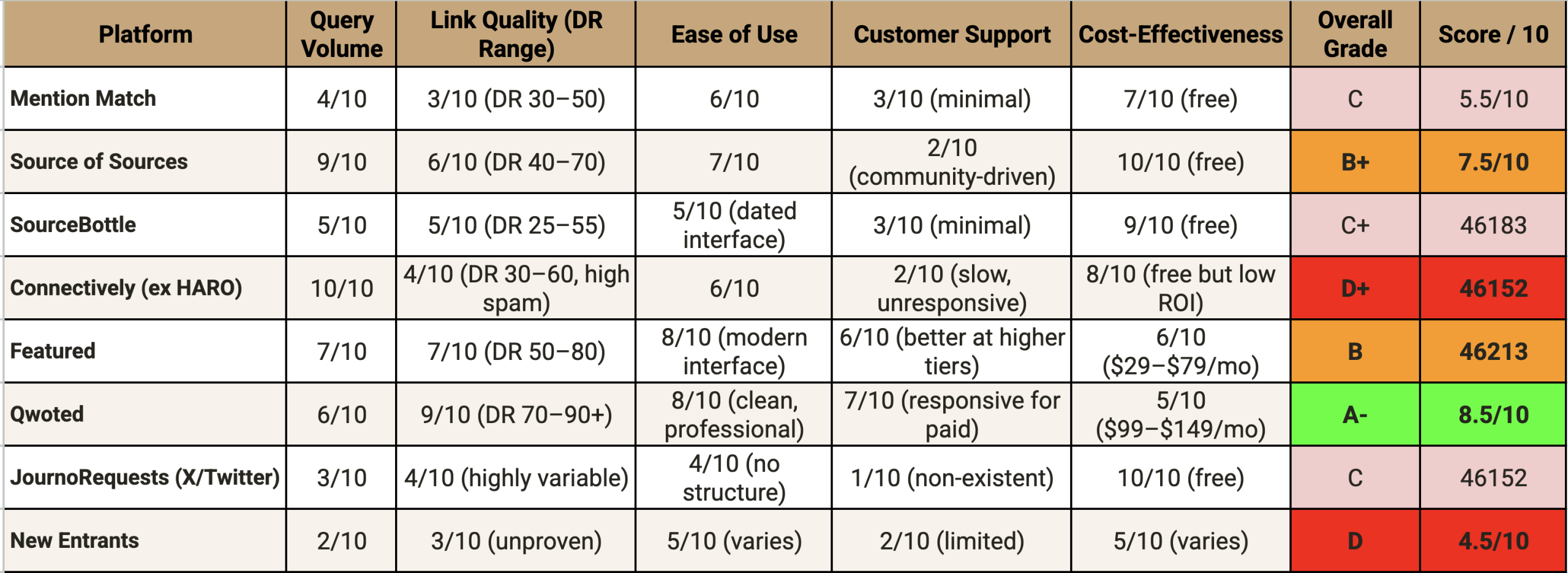
The table below compares all platforms across key metrics, including query volume, link quality, ease of use, customer support, cost-effectiveness and overall performance. Each platform receives a letter grade (A to E) and a score out of 10 based on aggregated performance data and user feedback.